
 +8618355102826
Hydrostatic Technology for High Precision Gear Machines
Hydrostatic Technology in CNC Machine Tools
The Foundation for Stable High Precision in Gear Grinding and Gear Milling Machines
In high precision gear manufacturing, machine accuracy depends not only on the CNC system and cutting tools, but more importantly on the structural support and motion system of the machine tool itself. In high-end CNC equipment such as gear grinding machines and gear milling machines, one core technology frequently mentioned yet not always intuitively understood is hydrostatic technology.
Hydrostatic technology is not a"visible"function, but it often determines the ultimate accuracy, operational stability, and long term reliability of a machine tool.
Why High End Gear Machines Rely on Hydrostatic Technology
During gear grinding and gear cutting processes, machine tools typically face three key challenges:
Very low feed rates with extremely high requirements for motion smoothness;
Large workpiece weight and cutting forces requiring high load capacity;
Long term accuracy retention without degradation over time;
Conventional sliding or rolling guideways often struggle to meet all these requirements simultaneously. Hydrostatic technology was developed specifically to overcome these structural limitations.
From"Sliding"to"Floating": How Hydrostatic Technology Works
In traditional machine tools, the slide is directly supported on the guideway surface. Even with lubrication, metal-to-metal contact cannot be completely avoided, leading to friction, wear, and low-speed stick-slip.
Hydrostatic technology takes a fundamentally different approach.
Active Support Instead of Motion-Based Lubrication;
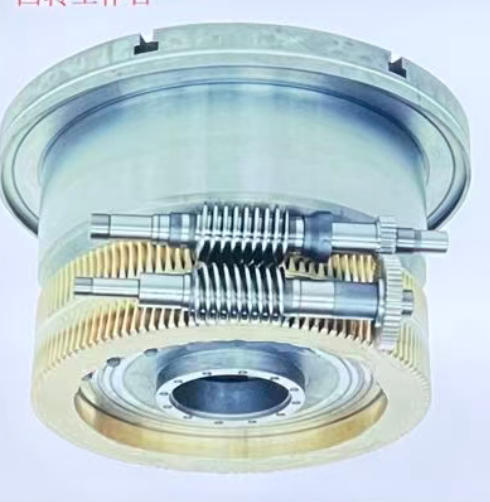
In hydrostatic guideways or hydrostatic bearings, an independent hydraulic system continuously supplies high-pressure oil into specially designed oil pockets through restrictors. Once pressure is established:
A stable load-carrying oil film forms between the moving components and the guideway
The oil film pressure is sufficient to support the component weight and cutting loads
As a result, the moving parts do not"slide"on the guideway. Instead, they are lifted and stably supported by a high pressure oil film, maintaining a controlled clearance typically ranging from a few microns to several tens of microns.

What Does"Floating"Actually Mean?
When metal surfaces are separated by a pressurized oil film, the machine's motion behavior changes fundamentally:
Almost zero friction, eliminating low speed stick slip
No guideway wear, allowing accuracy to remain independent of machine age
Smooth, vibration free motion, beneficial to gear profile accuracy and surface finish
This is why hydrostatic technology is indispensable in gear grinding machines and high precision gear milling machines.
Core Value of Hydrostatic Guideways in Gear Grinding Machines
Gear grinding is essentially the precise control of extremely small deviations. Whether for profile modification, lead correction, or hard gear finishing, guideway motion stability directly affects final gear quality.
With hydrostatic guideways, gear grinding machines achieve:
Ultra smooth micro-feed motion without creeping
Extremely high trajectory repeatability
Long term accuracy stability even after extended operation
Therefore, hydrostatic guideways have become standard in high end machines such as profile gear grinders, worm grinding machines, and internal & external gear grinding machines.

Advantages of Hydrostatic Technology in Gear Milling and Hobbing Machines
Compared with grinding machines, gear milling and hobbing machines are more challenged by heavy loads and fluctuating cutting forces.
Hydrostatic structures offer clear advantages:
Very high load capacity for large gears and heavy worktables;
Excellent resistance to cutting impact without loss of accuracy;
Stable rotary and linear motion, supporting multi axis interpolation and precise indexing;
As a result, many heavy duty vertical gear milling machines, large module hobbing machines, and multi-axis CNC gear cutting machines adopt hydrostatic technology on critical axes and rotary tables.
Is Hydrostatic Technology Suitable for All Machines?
Hydrostatic technology is not a universal solution.
Due to its:
Relatively complex system design;
Higher cost compared with conventional guideways;
Strict requirements for oil cleanliness and hydraulic control;
High end machine tools typically apply hydrostatic technology only to key motion axes and load-bearing components to achieve an optimal balance between performance and cost.
Hydrostatic Technology: The True"Foundation Capability"of High-End Machine Tools
Unlike CNC systems or cutting tools, hydrostatic technology is not easily visible or replaceable. However, it determines whether a machine tool can provide:
Stable low speed motion;
Long term accuracy retention;
Reliable performance for high end gear manufacturing;
For gear grinding machines and gear milling machines, hydrostatic technology is not a marketing feature, but a proven and essential foundation of advanced machine tool design.
CONTACT US
|
|
 Qing Yan Road3,Wuxi 214000 JiangSu China
 T/F:86-510-83570133
 M/We Chat: +8618355102826
 E-mail: info@golpmachinery.com